
Fair schedules for the ER

Medestra builds your emergency physicians' schedule: every shift covered, your department's written rules kept, the hard shifts shared evenly.

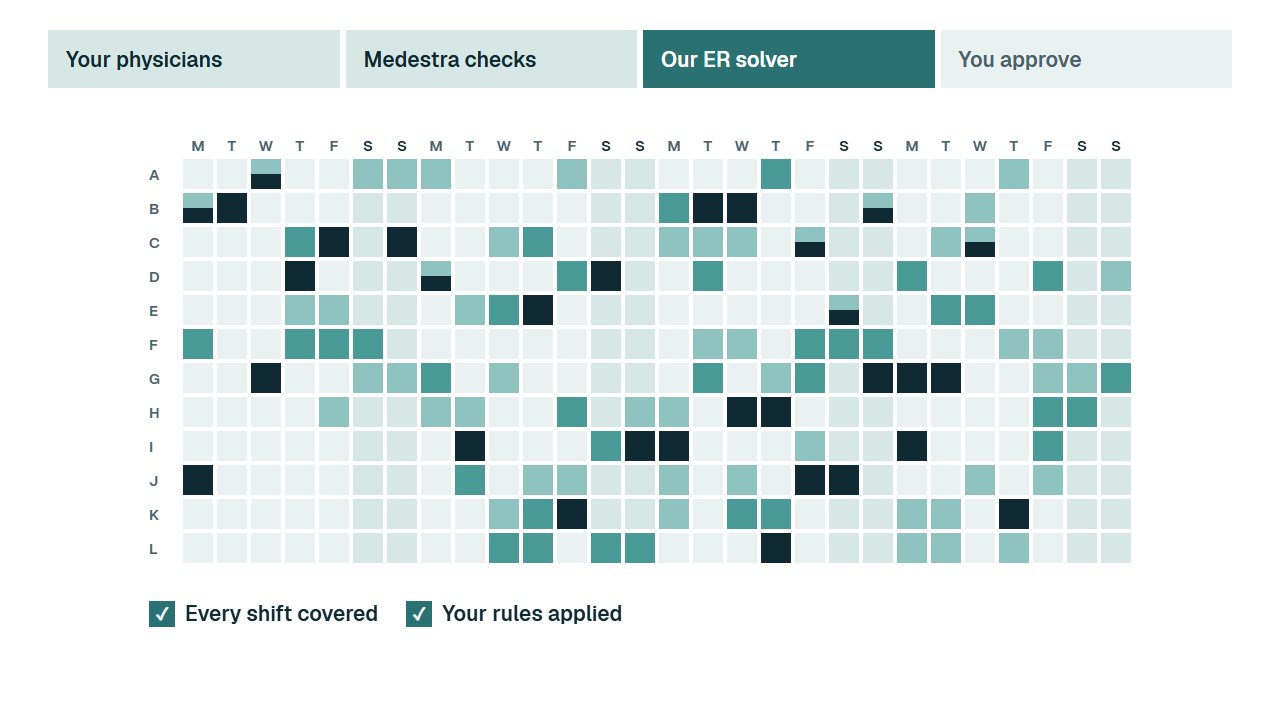
One scheduling period with Medestra: doctors' requests, the checks, the solver building the month, then publishing.

Against an ER's own schedule

Spring, summer and fall 2026 · 39 weeks · 3,448 required shifts

A Montreal ER. Same doctors, same shifts, same time off: the schedule the department worked, against the one Medestra built.

See one of these months →

Winter 2026–27, built by Medestra

Then the next period, built live. A Montreal ER, December 14 to March 14: 40 doctors, with most of the trauma team away over the holidays and spring break.

1,150

of 1,150 shifts covered: every one has a doctor

0

hard-rule breaks: rest, at most 5 shifts in 7 days, eligibility, work windows

0

doctors with three weekends in a row

0

doctors with more than one pair of back-to-back weekends

32

of 35 regular doctors work fewer than half of their weekends

Measured on the schedule Medestra published for the winter period, December 14, 2026 to March 14, 2027.

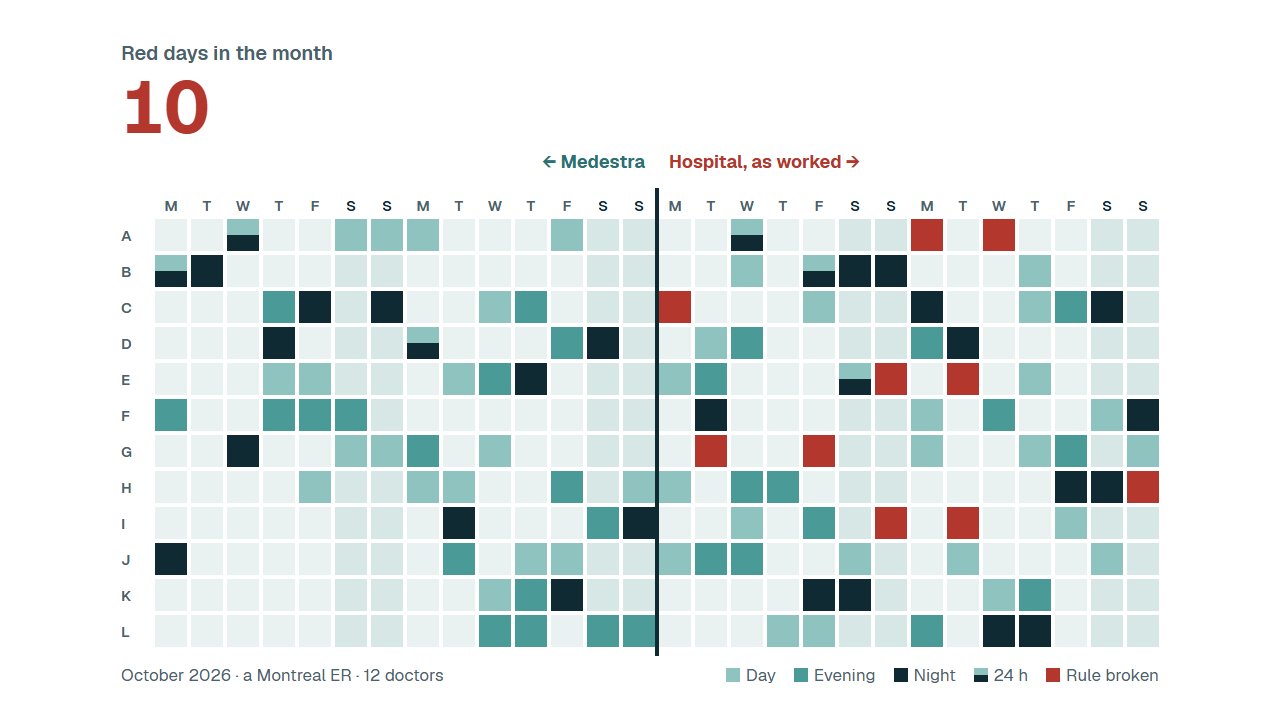
Hospital, as worked: 26 red daysMedestra: 0 red days
MTWTFSSMTWTFSSMTWTFSSMTWTFSSABCDEFGHIJKL
DayEveningNight24 hRule broken

One month, two schedules

October 2026 at a Montreal ER, for the 12 doctors with the most rule breaks in the worked schedule. A red day breaks a written rule or the 36-hour rest after nights. Drag across the month to compare.

Your rules, kept

Covered
1156 / 1156

Every shift coveredNo required position is left empty, ever.

NightNight36 hRest

36 hours after nightsRest after a night run is protected.

SatSunOffOff

Weekends spread outBack-to-back weekends kept rare.

Nights shared evenlyNo one carries the department's nights.

Target
33
Given
33

Why my numbers?Each doctor sees how their share was set.

Locked · 24 h

Lock a shift firstPre-assign; the solver builds around it.

Vacation

Time off from the phoneVacations and requests, entered by each doctor.

Four steps per period

  1. Your physiciansFirst, each doctor enters time off and preferences in the app.
  2. Medestra checksThen every input is audited against your rules, and each doctor verifies their numbers before any target goes out.
  3. Our ER solverNext, a solver strategy built for emergency departments breaks the period down and builds it, measured against your rules at every step.
  4. You approveLast, you review, publish, and trades open.

The app every physician carries

Each doctor has Medestra on their phone, in English or French.

  • See every shift, today's first
  • Enter time off, availability and preferences
  • Message the scheduling team
  • Get notified when the schedule changes
  • Swap shifts directly, or list one on the marketplace

Coming next: Shift Wormholes

Sometimes no two-person swap works: you want Dr B's Saturday, but Dr B doesn't want your Tuesday night. A Wormhole finds a circle of three to five doctors where each one gives a shift to the next and receives one that fits better.

ABCD
You giveTue · Night
You receiveSat · Day
  1. The app finds the circle among shifts doctors have listed for trade.
  2. Every shift is rechecked and held: no overlaps, and the rest between shifts protected.
  3. Everyone accepts the same offer. One no, and nothing changes.
  4. The scheduler confirms, and every shift changes at once, or none does.

Everyone receives a better-fit shift. The exchange completes only if all participants accept.

Who builds Medestra

Portrait of Nicholas Ponari

Nicholas Ponari

Co-founder

Health informatician, formerly at Merck, Baxter and Clinia. Founder of CareCircle and an investor in ClinCove. As CIO of ZealCare, he is researching how scheduling affects patient outcomes, with the University of Waterloo and the University of Toronto.

Portrait of Daniel Boisvert

Daniel Boisvert

Co-founder

Former vice-president at Intact, now a consulting data engineer.

Pricing

$0for one period

Run Medestra on your next period alongside your own schedule. Full access, no credit card. Compare the two, then decide.

Start a free period

Questions, answered

Three 2026 periods at a Montreal ER: spring, summer and fall. Both schedules use the same doctors, shifts and time off. The department's schedule is the one it actually worked. Both are counted by the same code against the department's written rules. On the hospital's own hardship score the results are mixed, and we say so.

Try it on your next period

Keep your own schedule. We build ours from the same inputs, and you compare them side by side.

Book a demo
The hospital's real October 2026 month at a Montreal ER, turned day by day into Medestra's schedule: 26 red days down to 0.